Read Flash Cards Study Guide Annotate Second Dbq Review Each Dbq W/rubric and Plan
Acing the AP® World History exam is undeniably a difficult task. Only 8.6% of students who took the 2019 exam scored a 5, and only 18.eight% of students scored a 4. The test's difficulty ultimately lies in how information technology forces you to clarify the overall patterns of history in add-on to the minor details.
Past familiarizing yourself with trends in history as opposed to just memorizing facts, y'all can get a five on the AP® World History exam. The test tin exist cracked by agreement how history operates, how the world changes through cause and effect. Admittedly, it tin be hard to larn how to study for the AP® World History test.
Even so, we're here to assistance you score a 5 and formulate the perfect AP® World History study plan. Through exercise and preparation, scoring a five is possible! Past taking AP® World History practice tests, creating a thorough study programme, and maintaining a daily study routine, y'all will be able to ace this examination.
Overall How To Written report for AP® World History: 9 Tips for 4s and 5s
one. Answer ALL of the questions
Make sure your thesis addresses every single part of the question being asked for the AP® Globe History free-response section. Many times, AP® World History prompts are multifaceted and complex, asking yous to engage with multiple aspects of a sure concept or historical era. Missing a single role can cost you significantly in the grading of your essay.
2. Lean one way in your argument
While it is possible to write essays that take two sides of an argument, information technology is ever easier to choose a side and defend it. Trying to appease both sides during a timed essay oft leads to an statement that'southward not about equally potent when you have a stance.
Here is an instance of a weak thesis:
The recovery of Russia and China after the Mongols had many similarities and differences .
Here is a amend i:
While both Russia and China built stiff centralized governments after breaking free from the Mongols, Russia imitated the culture and engineering science of Europe while Cathay became isolated and congenital upon its own foundations.
iii. Lead your reader
Help your reader understand where you are going as you lot answer the prompt to the essay. Provide them with a map of a few of the primal areas you are going to talk nearly in your essay. This should be done in your opening thesis paragraph. An easy fashion to attain this is by outlining what is going to be discussed in your body paragraphs during the introduction paragraph.
four. Organize your essay with ii-3-1 in listen
When outlining the respective topics you will exist discussing, start from the topic you lot know second best, and so the topic you know least, before ending with your strongest topic expanse. In other words, make your roadmap 2-three-ane and so that y'all exit your reader with the feeling that you lot have a strong understanding of the question being asked. This volition help scaffold your argument, and it volition brand the essay much more readable.
v. Analyze rather than merely summarize
When the AP® exam asks you to analyze, you want to think about the respective parts of what is being asked and look at the way they interact with one another. This means that when you are performing your analysis on the AP® Globe History test , y'all want to go far very articulate to your reader of what you lot are breaking down into its component parts.
For example, what show do y'all take to support a signal of view? Who are the important historical figures or institutions involved? How are these structures organized? How does this relate back to the overall alter or continuity observed in the world?
6. Utilize SPICER to organize and chunk your history reading
SPICER is a useful acronym that tin be used to clamper and break down history into six different categories:
- S – Social
- P – Political
- I – Intellectual
- C – Culture
- E – Economic
- R – Religious
These six categories encompass the major areas of history that you lot will see in your reading and on your examination. Write an S next to material that deals with social bug, an Due east near economical, so on and so forth. This volition intermission up your reading into more digestible chunks.
7. Familiarize yourself with the time limits
Part of the reason why nosotros advise practicing essays early on is and so that you lot get so good at writing them that y'all understand exactly how much fourth dimension y'all have left when yous brainstorm writing your 2d to the last paragraph. Y'all'll be so accepted to writing nether timed circumstances that you lot volition have no worries in terms of finishing on time.
The multiple-choice department is 55 questions and 55 minutes long, so you have 1 minute per question. The short respond section is 3 questions and 40 minutes long; the certificate-based question is 1 question and timed at one hour. The long essay is i question and timed at 40 minutes.
viii. Learn the rubric
If you have never looked at an AP® Globe History grading rubric earlier you enter the examination, you are going in blind. You must know the rubric like the back of your paw and then that you tin ensure you tackle all the points the grader is looking for. Here are the 2019 Scoring Guidelines .
While all the rubrics for the DBSs vary a bit, they mostly follow a 0-iii scale where each number represents a sure job you must fulfill within your response. The DBQ section is graded on a iv-scale basis:
- A) Thesis/Claim
- B) Contextualization
- C) Evidence
- D) Analysis and Reasoning
The thesis component evaluates the strength of your thesis statement, while the contextualization section evaluates your ability to describe a broader historical context relevant to the prompt. The evidence part of the rubric evaluates your analysis and employ of the texts, and the assay and reasoning section evaluates your statement overall.
ix. Familiarize yourself with analyses of art
This i is optional, but a bang-up way to really get used to analyzing art is to visit an art museum and to heed to the way that art is described. Often the examination volition brand y'all either translate the artist's intent and perspective or forcefulness you lot to expound on history through interpretation of the painting.
Here'southward an example.
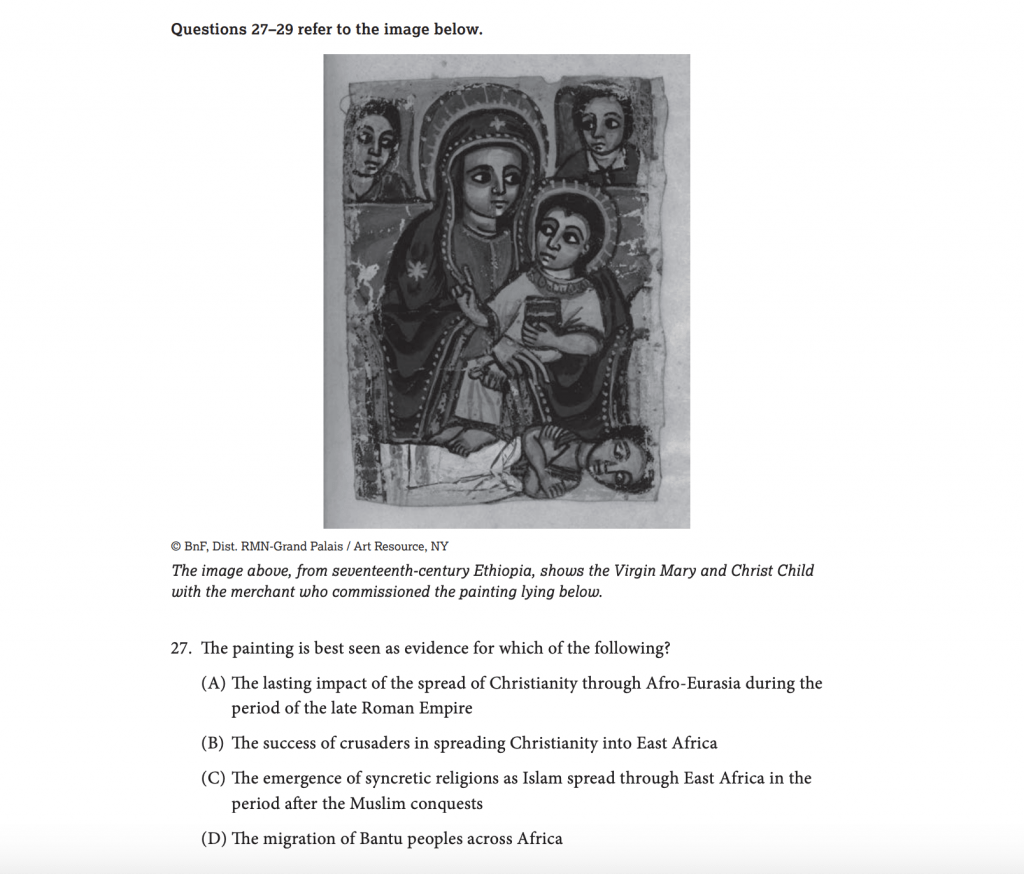
Detect how the painting is existence used to assess an entire historical era. The painting is being used here equally much more than a painting.
Return to the Table of Contents
Render to the Table of Contents
AP® World History Multiple Choice Review: xi Tips
1. Identify fundamental patterns of history
Yous know that proverb, history repeats itself? At that place'south a reason why people say that, and that is because at that place are fundamental patterns in history that can be understood and identified. This is particularly true with AP® World History .
Recall almost patterns similar crusade and issue, action and reaction, dissemination and reception, oppressor vs. oppressed, etc. History can be best comprehended when you recognize patterns.
ii. Utilise common sense
The beauty of AP® World History is when you sympathize the core concept being tested and the patterns in history; you can deduce the reply to the question. Place what exactly is being asked and then go through the process of elimination to figure out the correct answer.
Now, this does not mean you exercise not study at all. This means, rather than study 500 random facts virtually world history, really hone in on understanding the way history interacts with different parts of the globe.
Recollect about how minorities accept changed over the grade of history, their roles in club, etc. Y'all want to wait at things at the big picture so that you can have a strong grasp of each time menstruation tested.
3. Familiarize yourself with AP® Earth History multiple-choice questions
If AP® World History is the starting time AP® test you've ever taken, or even if it isn't, you need to go used to the fashion the College Board introduces and asks you questions. Notice a review source to exercise AP® World History questions.
Albert has hundreds of AP® World History do questions and detailed explanations to work through. These questions are designed to embrace tons of years of World History, so you must become acquainted with how that history is presented to you.
iv. Make a annotation of pain points
As you practise, you'll quickly realize what you know really well, and what you know not so well. Figure out what yous practise not know and then well and re-read that chapter of your textbook. Keep a nautical chart or log of what yous do not practice quite so well, and so when it comes fourth dimension to review, you can quickly discern which area y'all need to study. Then, create flashcards of the fundamental concepts of that affiliate along with key events from that time menstruum.
5. Supplement exercise with video lectures
A fast fashion to larn is to do practice problems, place where you lot are struggling, learn that concept more intently, and then practice again. Crash Course has created an incredibly insightful series of Earth History videos y'all tin can scout on YouTube hither . And Useful Charts offers tons of dandy timeline-oriented videos on enough of subjects including world history.
Afterward, become back and practice again. Exercise makes perfect, specially when it comes to AP® World History. And a lot of these videos are really pretty interesting.
6. Strikeout wrong reply choices
The second you can eliminate an answer selection, strike out the letter of that respond choice and circle the word or phrase backside why that answer choice is incorrect. This way, when you review your answers at the very cease, you lot can chop-chop bank check through all of your answers.
I of the hardest things is managing fourth dimension when you're doing your second run-through to check your answers—this method alleviates that problem by reducing the amount of time it takes for yous to recollect why you thought a certain answer option was wrong.
seven. Respond every question
If you're crunched on fourth dimension and even so take several AP® Earth History multiple-choice questions to answer, the all-time thing to do is to make sure that you respond each and every 1 of them. There is no guessing penalty for doing then, so have full advantage of this!
eight. Skip questions property y'all up and return to them later on
If you detect yourself spending more than a infinitesimal or so on a question, don't let yourself become stuck. Instead, circle the number of the question, skip it, and render to it subsequently if you have fourth dimension. Since this is a timed component of the exam (55 minutes), the pacing is essential to scoring high. If you find yourself getting stuck, don't fixate. Circumvolve then move on and return.
nine. Don't be afraid to make educated guesses
This one dovetails nicely with the preceding tip. If you lot find yourself totally at a loss choosing an answer on the AP® Globe History multiple-option section, make an educated judge. You are not penalized for answers you miss; your scores are counted by how many yous get right. So it's in your benefit to answer every question and exit none blank. And then, when confronted with impossibly hard questions, try and narrow the choices down a bit and so but make an educated guess.
10. Continue your eyes peeled for respective questions that provide answers
Sometimes, in multiple-choice exams, questions tin actually sort of answer each other. For example, say question 12 depicts a painting of the 1789 Storming of the Bastille, and question 30 asks you to depict the mood of the belatedly-eighteenth century France, yous can use question 12 to help you reply question thirty. Since many of the events in AP® World History correspond, y'all will likely meet instances of this. Utilise it to your reward.
11. Form a written report group
Developing a potent memory of historical dates, events, figures, and all the stuff essential to AP® World History is crucial to acing the multiple-option component of the exam. I way to build your memory is to form a study group with your classmates and meet weekly or bi-weekly. Before you run into, plan out which parts of world history you desire to cover, and stick to it. Choose your group wisely because sometimes, report groups tin quickly turn into hang-out sessions.
Return to the Tabular array of Contents
AP® World History FRQ: 17 Tips
1. Group the documents by intent
I skill tested on the AP® examination is your ability to relate documents to one another–this is called group. The thought of grouping is to essentially create a dainty mixture of supporting materials to bolster a thesis that addresses the DBQ question being asked. In order to group effectively, create at least 3 different groupings with two subgroups each.
When you group, group to respond to the prompt. Practice non group just to bundle certain documents together. The best illustration would be y'all take a few dissimilar colored buckets, and you want to put a label over each bucket. And then you lot accept a variety of different colored balls in which each color represents a document, and you want to put these balls into buckets. You can have documents that fall into more than one group, but the large picture tip to call up is to group in response to the prompt.
This is an absolute must. 33% of your DBQ grade comes from assessing your ability to group.
2. Assess POV with SOAPSTONE
SOAPSTONE helps y'all reply the question of why the person in the certificate made the slice of information at that time. Recall that SOAPSTONE is an acronym:
- Due south – Speaker
- O – Occasion
- A – Audience
- P – Purpose
- Southward -Subject
- Tone – Tone
It answers the question of the motive backside the document and tin help you engage with the documents more than effectively.
three. S represents Speaker or Source
You want to brainstorm by asking yourself who is the source of the certificate. Think about the background of this source. Where do they come from? What do they practise? Are they male or female person? What are their respective views on faith or philosophy? How former are they? Are they wealthy? Poor? Etc. Understanding the source of the text will help unlock its nature, and it will let yous to approach the reading with a specific angle in mind.
4. O stands for occasion
You desire to ask yourself when the document was said, where was it said, and why information technology may have been created. You lot can also remember of O equally representative of origin. Analyzing the occasion or origin of a historical text will provide you with much-needed context, which is essential to decoding history. When y'all face up a text, immediately ask yourself what the occasion of the text is.
five. A represents audition
Call up about who this person wanted to share this document with. What medium was the certificate originally delivered in? Is it delivered through an official document, or is it an artistic piece like a painting? The intention behind a slice is crucial to understanding its meaning. If you can figure out who the text was intended for, then you tin can begin to unpack what it is all about. The audience is crucial.
6. P stands for the purpose
After you've asked who the audience of the text is, begin asking, "why?" Recall, "why did this person create this document?" or "why did they say this or that?" What is the main motive behind the document? Obviously, unpacking the purpose of a text is essential to understanding it as a whole, and, again, it serves as an essential step in the process of breaking down the text.
7. Due south is for the subject of the document.
Next is the discipline. Every text addresses a broader or larger field of study either implicitly or directly, and understanding this will assist chunk your reading and make your writing more sophisticated. For example, the Silk Road is a trading route, certain, but it is also more than broadly about the rise of globalism and international relationships. WWI is, of course, a catastrophic war, but it'southward also about the ascension of technology, international discord, humanitarianism, and even masculinity. When y'all read a historical text, call back, "what is this actually well-nigh?"
8. TONE poses the question of what the tone of the document is.
This relates closely to the speaker. The tone is a general character or attitude of a identify, piece of writing, or a situation. Writers create tone through a diversity of ways but pay special attention to strong vocabulary words, key phrases, literary or rhetorical devices, mood words, and more elements of writing that generate the tone. Highlight or underline them. Recollect about how the creator of the certificate says certain things. Think about the connotations of certain words.
9. Explicitly state your analysis of POV
Your reader is not psychic. He or she cannot only read your heed and empathize exactly why you are rewriting a quotation by a person from a document. Be certain to explicitly country something along the lines of, "In document Ten, author states, "[quotation]"; the writer may use this [x] tone because he wants to signify [y]." Another example would be, "The speaker's belief that [speaker'south opinion] is made articulate from his usage of especially negative words such equally [xyz]."
ten. Exist witting of how y'all use data from charts and tables
Sometimes you'll come beyond charts of statistics. If you practise, ask yourself questions similar where the data is coming from, how the information was nerveless, who released the information, etc. Y'all substantially want to take a like arroyo to SOAPSTONE with charts and tables. Data should be analyzed rather than merely summarized.
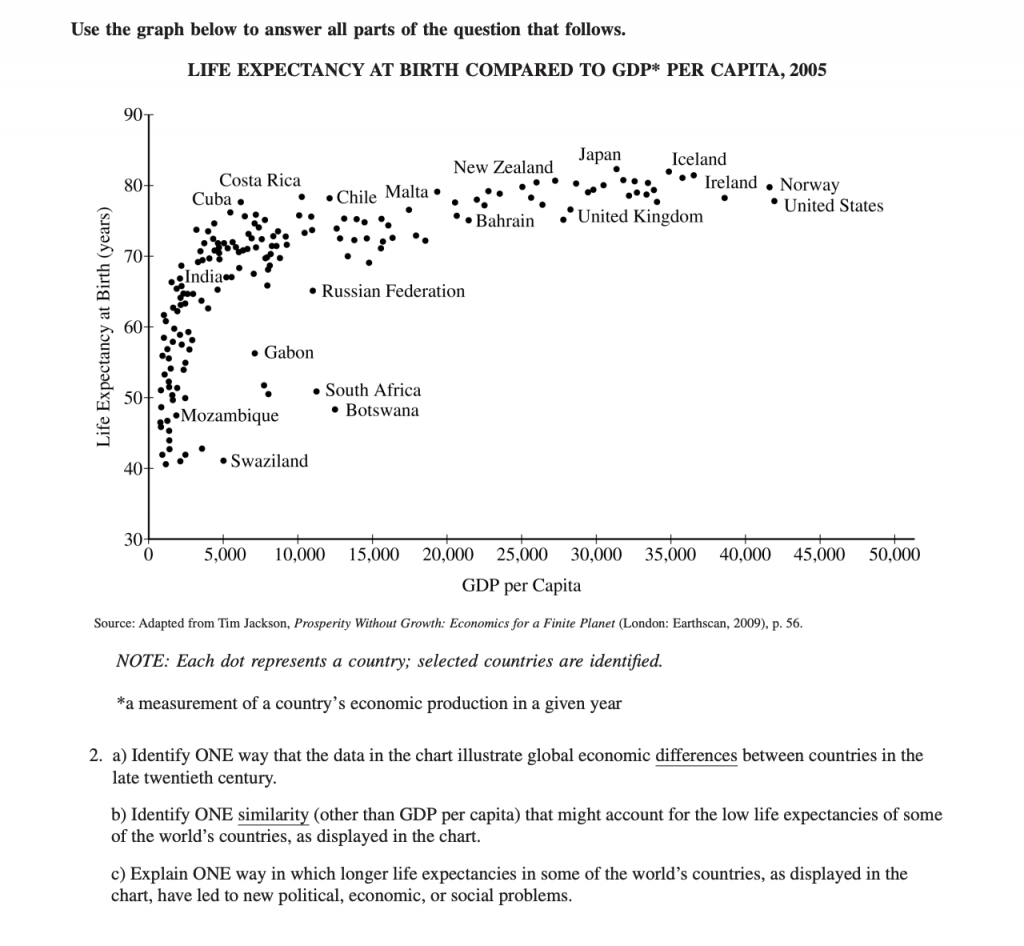
Notice how the prompt asks you to either "identify" or "explain." If you lot choose to answer i of the questions with "identify," y'all must become much farther than simply identifying. You must motility into the realm of "explain" and "analyze."
eleven. Appraise maps with a strategy in heed
When you come beyond maps, wait at the corners and centre of the map. Recollect well-nigh why the map may be oriented in a sure way. Think about if the title of the map or the legend reveals anything about the culture the map originates from. Retrieve well-nigh how the map was created–where did the information for the map come from. Think about who the map was intended for.
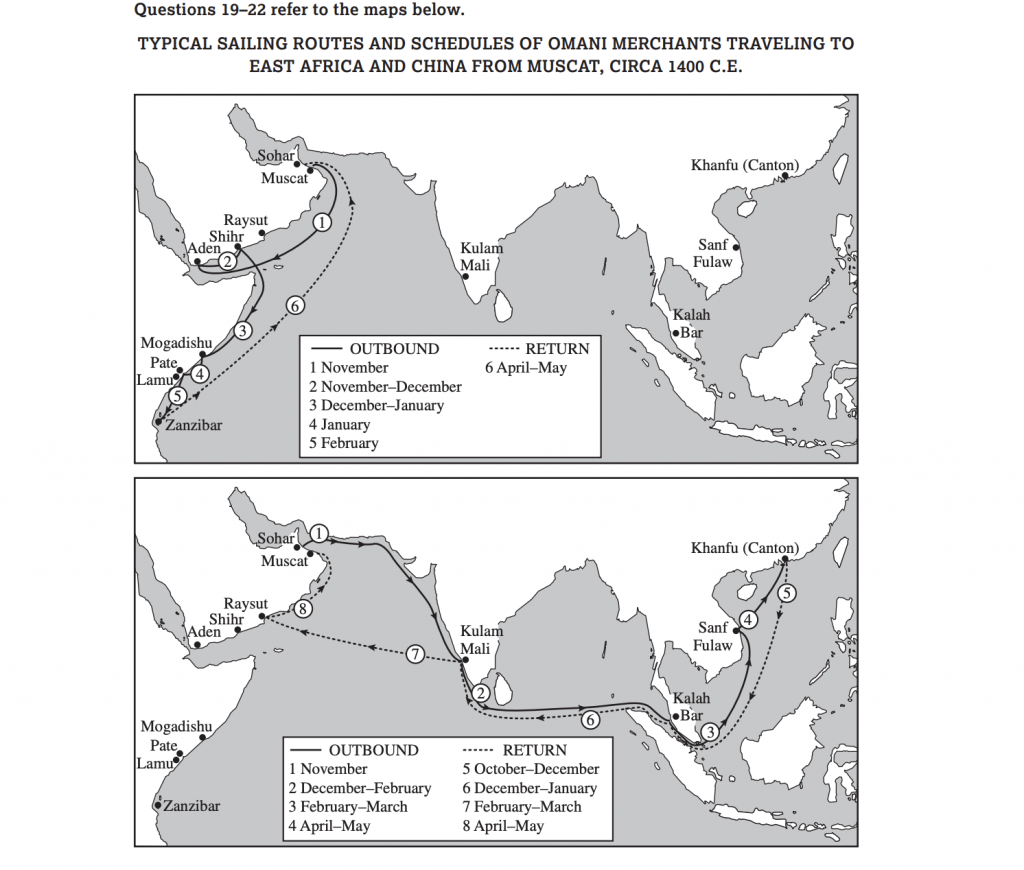
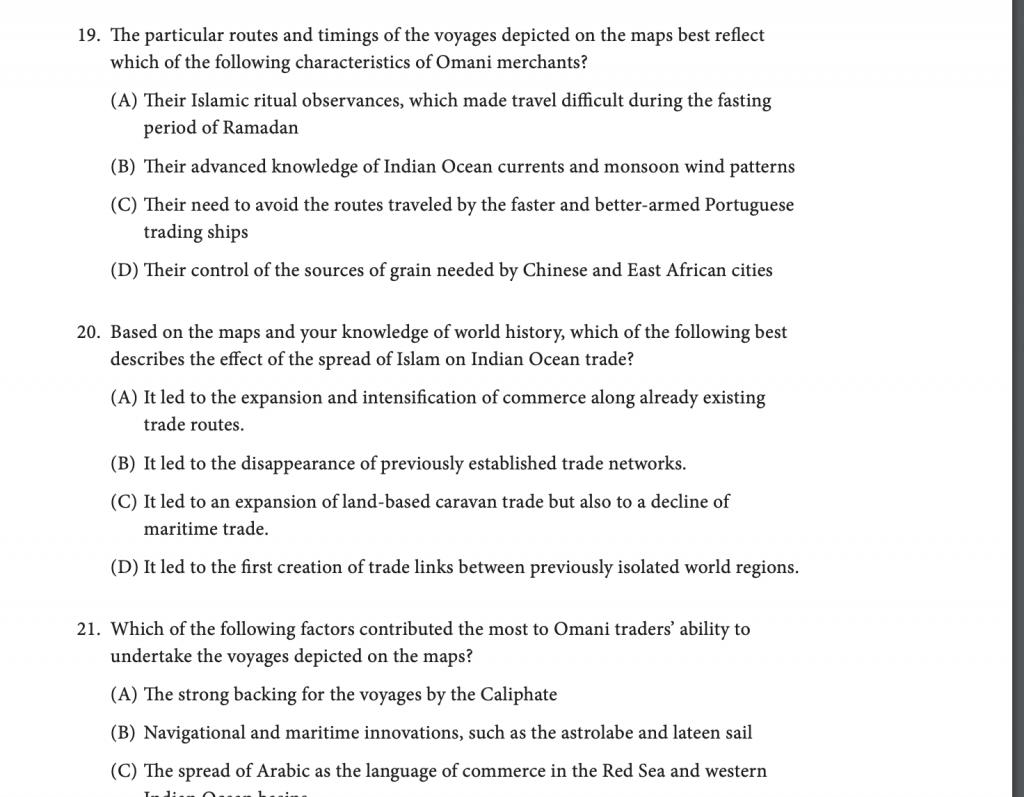
12. Assess cultural pieces with SOAPSTONE in mind
If you come beyond more artistic documents such every bit literature, songs, editorials, or advertisements, y'all want to really think about the motive of why the piece of art or creative writing was made and who the document was intended for. What does that specific slice tell you lot near the time in which information technology was created?
thirteen. Be careful using coating statements
Just because a certain point of view is expressed in a certificate does non mean that POV applies to everyone from that historical area. One common problem students brand is expressing one sentiment for a large grouping of people, events, or historical eras. Be aware that history tin can rarely exist reduced to 10 = Y. A grey surface area persists. 1 easy fashion to avoid this pitfall is to be every bit specific as possible. Take a look at these examples from the 2019 exam:
Blanket argument: "During 1450 to 1750 the creation of the Mongol Empire changed the part of nomads in cultural exchange. Before the Mongols, nomads acted as traders who spread trade and civilization along routes, simply this changed during the Mongol Empire, nomads became the protectors who patrolled the merchandise routes to keep them safe."
Notice how the writer paints nomadic tribes with too wide of a wide castor and does not discuss their trade with enough specificity.
Now here'southward a more specific example:
"One development that changed the role that Primal Asian Nomads played in cross-regional exchanges from the catamenia 1450– 1750 C.E., as described in the passage, was the evolution of maritime technology considering new modes of transportation across the sea using boats and knowledge of monsoon winds immune countries to merchandise and exchange ideas and goods across regions with less overland utilize, which diminished the importance of central Asian nomads in exchanging goods and ideas and cultures overland. An example of this includes European maritime empires such as Britain and Portugal, who navigated to Asia on body of water in guild to trade at trading posts. This sufficiently decreased central Asian nomads' need to exchange goods along the Silk Route from Europe to Asia."
Source: Chief Reader Report
Notice how specific the author is when discussing the nomads' trading.
14. Understand that bias will always exist
Even if you're given data in the form of a table, there is bias in the data. Practice not fall into the trap of thinking just because at that place are numbers it means the numbers are foolproof. Bias can and should be withdrawn from whatsoever and all sources.
Hither'south an example of a bias historical statement: The Russian Revolution was initiated by an angry lower-class looking for revenge against a greedy ruling class.
While this may be somewhat truthful, notice how the words "angry" and "greedy" indicate particular moods toward these subjects from the writer.
Instead, the statement should exist written as "The Russian Revolution was initiated by Russia'due south lower course confronting the ruling monarchy.
15. Exist artistic with introducing bias
Many students empathize that they need to show their understanding that documents tin be biased, but they go most it the wrong way. Rather than outright stating, "The document is biased considering [ten]," try, "In document A, the author is conspicuously influenced past [y] as he states, "[quotation]." Encounter the difference? Information technology's subtle but makes a clear divergence in how you demonstrate your understanding of bias.
sixteen. Don't forget to B.S. in your DBQ
No, no. It's not what you're thinking. By B.S., we hateful to be specific. When you are discussing a certain revolutionary leader, an economical policy, a governmental deed, or some other dissimilar aspect of AP® World History, be sure to specifically name your topics. Practise non just generalize, but B.S.!
Here'due south an example of a general argument: " While both sides fought the Ceremonious War over the effect of slavery, the Northward fought for moral reasons while the South fought to preserve its own institutions."
And hither's one that's more specific: "While both Northerners and Southerners believed they fought against tyranny and oppression, Northerners focused on the oppression of slaves while Southerners defended their ain correct to self-authorities."
17. Leave yourself out of it
Do non refer to yourself when writing your DBQ essays! "I" has no place in these AP® essays. Academic essays need to remain professional and focused, and the introduction of "I" detracts from that tone. And the reader already knows that your essay is written from your perspective, so an "I" is just redundant.
Return to the Table of Contents
Tips Submitted past AP® World History Teachers
Overall AP® World History Tips
1. Apply high polymer erasers
When answering the multiple-choice scantron portion of the AP® Globe History test, utilise a high polymer eraser. Information technology is the merely eraser that will fully erase on a scantron. Amazon carries enough for cheap. Thanks for the tip from Ms. J. at Boulder Loftier School.
2. Stay ahead of your reading and when in doubt, read again
Yous are responsible for a huge amount of information when it comes to tackling AP® World History, so make certain you are responsible for some of it. Create a daily reading habit where you spend at to the lowest degree an hour per day digesting your AP® World History material. At that place is simply too much for you to try and cram. And you can't leave all the work upwardly to your instructor. Information technology's a squad effort. Thank you for the tip from Mr. Eastward at Tri-Central High.
3. Integrate video learning
A nifty way to really solidify your agreement of a concept is to watch supplementary videos on the topic. Crash Grade offers a lot of bang-up video content on Earth History, and Heimler's History does as well. And so, after watching a video, read the topic again to truly master information technology. Cheers for the tip from Mr. D at Royal High School.
4. Practice with transparencies or a whiteboard
Use transparencies or a whiteboard to create overlay maps for each of the 6 periods of AP® World History at the start of each menses and so that you tin come across a visual of the regions of the earth being focused on. History is perfect for big whiteboards because they allow you lot to draw out big maps, event chains, and more than. Thank you for the tip from Ms. W at Riverbend High.
AP® Globe History Multiple-Choice Tips
one. Read every word
Oftentimes in AP® World History , many questions tin can exist answered without specific historical knowledge. Many questions require disquisitional thinking and attention to item; the difference betwixt a correct answer and an wrong answer lies in merely one or two words in the question or the respond. Exist aware of answer choices similar "none of the above" or "all of the above," every bit either none or all of the questions must be right or wrong. Keep that totality in mind. Cheers for the tip from Mr. R. at Mandarin Loftier.
2. Wait at every answer option
Don't go for the kickoff "correct" answer; observe the well-nigh "impenetrable" answer. The one you'd best exist able to defend in a debate. Recollect of the "bulletproof" answer as an reply which can exist tested and tested and tested just still holds upward. Run this through your head while choosing an reply, and constantly reevaluate.
3. Comment the text
Textbook reading is essential for success in AP® World History, only learn to annotate smarter, not harder. Be efficient in your reading and note-taking. Read, reduce, and reflect. To read – utilise sticky notes. Using post-its is a lifesaver – use different color stickies for different tasks (pink – summary, bluish – questions, dark-green – reflection, etc.) Reduce – go back and look at your mucilaginous notes and see what you lot tin can reduce – decide what is truly essential material to know or question. So reflect – why are the remaining sticky notes of import? How will they assistance yous not just understand the content, just besides sympathise contextualization or causality or change over time? What does this information prove yous? Thanks for the tip from Ms. J at Legacy Loftier.
AP® World History FRQ Tips
ane. Master writing a skillful thesis
In order to write a skillful thesis, you want to brand sure it properly addresses the whole question or prompt, effectively takes a position on the primary topic, includes relevant historical context, and organize key standpoints. Heimler's History has a proficient how-to guide on AP® Earth History thesis statements that'due south certainly worth checking out. Thanks for the tip from Mr. Grand at Loganville High.
2. Tackle DBQs with Sorry and BAD
With the DBQ, think most the S ummary, A uthor, and D ate & Context. Also, consider the B ias and A dditional D ocuments to verify the bias. Thanks for the tip from Mr. G at WHS.
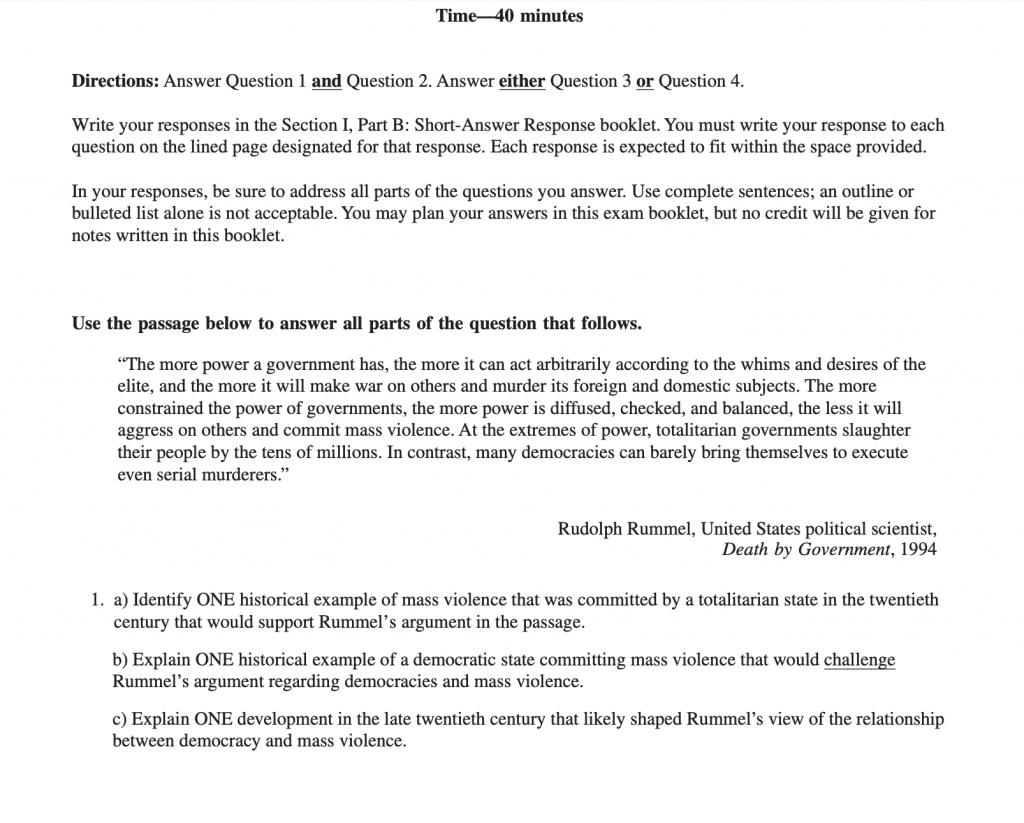
Become through this prompt from the 2019 test and notice how SAD and BAD work well. It is virtually totalitarian governments past Rudolph Rummel, a US political scientist, from 1994. Does it nowadays whatever bias? Boosted documents? Sorry and BAD can.
three. Create a refined thesis in your conclusion
Do not just blow off your decision paragraph. Recall of the decision every bit the decorative bow that nicely holds the box together. By the time you stop your essay, you have a much more than clear thought of how to answer the question. Take a infinitesimal and revisit the prompt and try to provide a much more explicit and comprehensive thesis than the one yous provided in the starting time as your conclusion. This thesis argument is much more likely to give yous the point for the thesis than the rushed thesis in the beginning. Thanks for the tip from Mr. R at Mission Hills Loftier.
4. Relate dorsum to the themes
Understanding 10,000 years of earth history is hard. Knowing all the facts is darn near impossible. If you lot tin can use your facts/material and explain information technology within the context of one of the APWH themes, it makes it easier to process, empathize, and apply. The themes are your friends. Thanks for the tip from Ms. J at Legacy High.
five. Look for the missing voice in DBQs
Beginning, expect for the missing voice. Who haven't yous heard from in the DBQ? Who's vocalization would actually help you answer the question more completely? Next, if there isn't really a missing vocalization, what show do you lot take access to, that you would like to clarify? For example, if yous have a document that says excessive taxation led to the fall of the Roman Empire, what other pieces of information would you similar to accept access to that would help you show or disprove this statement? Perhaps a nautical chart that shows tax amounts from prior to the 3rd Century Crisis to the mid of the 3rd-century crunch? Thanks for the tip from Ms. J at Legacy Loftier.
Return to the Table of Contents
Wrapping Things Up: The Ultimate List of AP® Earth History Tips
Doing well in AP® World History comes down to recognizing patterns and trends in history, and familiarizing yourself with the nature of the exam. Students often think the key to AP® history tests is memorizing every single fact of history, and the truth is you may be able to do that and get a 5, but the smart way of doing well on the test comes from understanding the reason why we study history in the start identify.
Past learning the underlying patterns that are tested on the exam, for instance, how opinions towards women may have influenced the social or political landscape of the world during a certain time menstruum, you can create more compelling theses and demonstrate to AP® readers a clear understanding of the bigger picture.
The lesser line is this: in order to ace this exam, yous accept to ready. We offer tons of AP® World History practice questions , practise exams , AP® World History DBQs , and more. Nosotros recommend that y'all accept a look at our extensive catalog, and develop a daily written report routine. With this proper preparation, you will ace the exam!
Source: https://www.albert.io/blog/ap-world-history-tips/
0 Response to "Read Flash Cards Study Guide Annotate Second Dbq Review Each Dbq W/rubric and Plan"
Post a Comment