Amy Cutler Paintings and Drawings
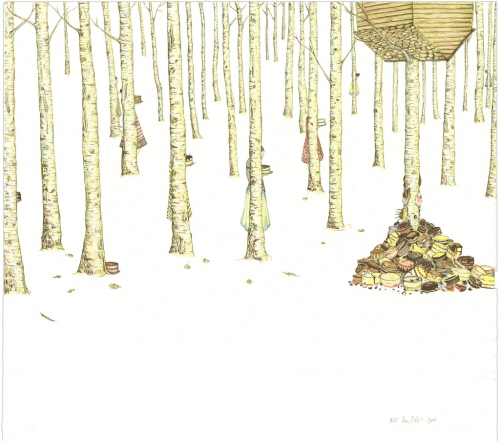
Amy Cutler. "Cake Toss," 2004. Lithograph in colors on Fabriano Artistico Hot Printing natural white, 21-one/2 x 24 inches (image and sheet). Edition: 39; publisher: Universal Limited Fine art Editions, Bay Shore, NY. Courtesy Leslie Tonkonow Artworks + Projects, New York.
Fantastical narrative is a guiding principle for many artists who have come to prominence in the past decade; Amy Cutler and Dana Schutz are foremost among these. Both possess extraordinary imaginative powers, creating worlds that are entirely fresh and singular. This calendar month'due south and the subsequent post of Ink will focus on the prints of these two immature artists, respectively, both of whom have created a significant number of prints that direct relate to their paintings and drawings.
Amy Cutler'south globe is populated by plain women who hail from an imaginary or foretime era. They wear vaguely traditional clothes of the artist'due south invention, informed by an constructing of periods and cultures, and engage in surreal or unlikely tasks, often with serious or sober expressions. Like many contemporary artists (i.e., Enrique Chagoya, Kara Walker, Laylah Ali, Shahzia Sikander), Cutler has reached beyond the history of Modernistic fine art for inspiration, finding a new vocabulary in which to accost the contemporary condition. The artist has cited Persian miniatures, fifteenth-century German painting, Japanese ukiyo-eastward, and medieval art as influences in her work, equally well every bit the folkloric heritage of the Brothers Grimm (see Lisa Freiman, "The Marvelous World of Amy Cutler," in Amy Cutler [Ostfildern, Deutschland: Hatje Cantz Verlag, 2006],10). These precedents are certainly apparent in Cutler'southward jewel-like compositions that are lavished with minute detail. Her technique is alluringly skilled, only this is by no means the focus (when her procedure is mentioned, it is usually to annotation the meticulous style in which she applies patterning to textiles). Instead, any such description is primarily an enriching factor in the creative person's bizarre narratives that instantly capture the imagination.
Though Cutler'due south work has sometimes been dismissed equally illustrative (a tendency abhorred past an older generation of critics and artists), this is the very quality that contributes to its fallacious power. Cutler'southward attention to detail grounds the piece of work in specificity; the objects and environments they depict are recognizable and appealing. These familiar elements rope the viewer into a process of telling a story to "make sense" of it. This impulse is noted past Freiman and analyzed in further depth past curator Laura Steward in her introduction to the catalogue for Cutler's recent exhibition at SITE Santa Fe: "your impulse is to imagine a narrative that could accept place in the scene she depicts, and further, to imagine what that narrative might mean" (Amy Cutler: Turtle Fur [Ostfildern, Frg: Hatje Cantz Verlag, 2011],12). Yet there is no such meaning to be found; estimation is intentionally left open-concluded.
Cutler thus deftly awakens the viewer'south coercion to apply "morals" to her tales. 1 common response is a feminist one – the industriously toiling women of Cutler's world are oftentimes engaged in "women'due south work" of an absurd nature, prompting empathy or outrage for their perceived thankless labor. Yet Cutler's intention is contrary to this agreement. Addressing her proclivity for female person subjects in an interview with Aimee Bough, she states "I love the idea of a fictional utopia of women who are strong and self-reliant" (ibid., 23). She also notes that her feel of attention an all-girls schoolhouse may take influenced this preference. Likewise, she does non espouse the idea that her women are engaged in drudgery. When questioned on this point, she explains, "I think information technology comes from my fascination with annihilation that is meticulously crafted – things that are created by individuals with specifically honed skills…I am especially drawn to methodical work that requires a lot of concentration…[T]he rhythm and repetition…lends itself to introspection" (ibid., 22-3).
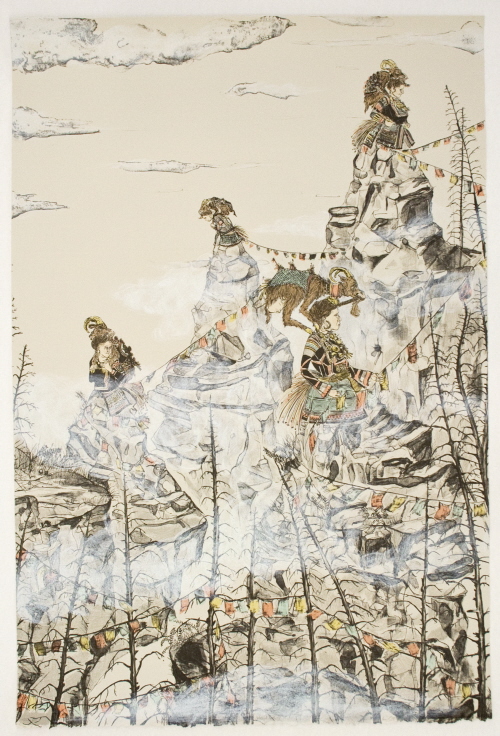
Amy Cutler. "Widow's Summit," 2011. Lithograph in ten colors, 36¼ ten 24½ inches (image and sail). Edition: 25; publisher: Tamarind Institute, University of New United mexican states, Albuquerque; collaborating printer: Bill Lagattuta. Courtesy Tamarind Institute.
Though grounded in story-telling traditions, Cutler'due south dream-similar images (which are often tinged with the macabre, like folk tales) are entirely gimmicky in their exploration of the casuistic and contradictory. In 2005, Cutler shared her interest in the hidden and associative processes of the mind with Freiman: "[d]aydreams and things that I so often practice non hear correctly constantly enter my work. If something sounds strange, I turn it into a mental picture show and that is very entertaining" (Amy Cutler [2006], 20). The creative person too makes a concerted endeavor to draw her dreams in a journal, and sometimes these become elements in her finished work. Though Cutler does not cite Surrealism as a straight influence, Freiman notes in her essay that these practices were besides embraced past its leader André Breton, "so that the artist'due south imagination could roam freely, unencumbered by the obligation to create realistic representations of life" (ibid., 21). Indeed, Cutler'due south women are often doing something impossible that could only exist in the realm of painting, drawing, and prints, where the laws of physics and other parameters of the "existent" earth can be stretched.
Likewise, Cutler departs from the narrative graphic traditions of the past in her spare description of setting. Her figures often float in blank field of open paper, or with minimal description of surroundings. She explains, "I trust that the viewer is able to follow and understand the spatial relationships within the painting without every detail having been laid out. I see the absence of a literally described identify as an entry point in the painting…the viewer becomes an active participant in the cosmos of this world" (as quoted in Bender, Amy Cutler: Turtle Fur, 22). As discussed by Steward, this engagement from the viewer is intrinsic to Cutler's art. Using Susan Sontag'south ground-breaking 1966 essay "Against Interpretation" as a counterpoint, Steward argues that Cutler'due south piece of work (and those of her agreeing contemporaries) actively encourages interpretive looking – fifty-fifty depends upon it – in a way that Sontag never could have imagined. In a break from the abstract, and arguably "content-less" fine art of the Postwar catamenia (which was Sontag's discipline), today'due south narrative art resists the technique- and biographically-based discussion that defined Modern criticism, intensely engaging the viewer in quixotic worlds that curtail whatsoever such assay.
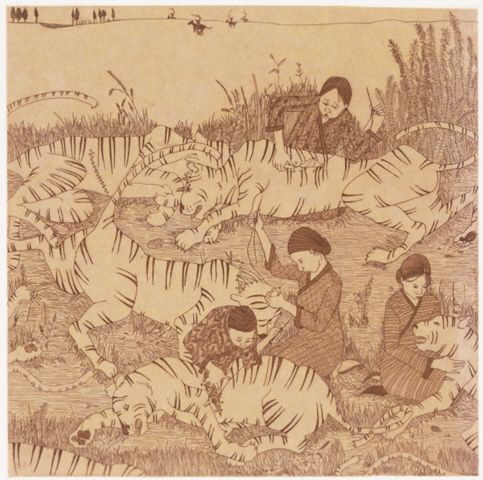
Amy Cutler. "Tiger Mending," 2003. Etching and aquatint in sepia with chine collé, 9 7/8 x 9 7/8 inches (image), 19-one/2 10 sixteen-iii/4 inches (sheet). Publisher: Lower E Side Printshop, New York. Courtesy Lower E Side Printshop, New York.
As Cutler has made clear in interviews and artist'southward talks (see her recent talk at Site Santa Fe – also excerpted here), her subjects are ofttimes born of personal feel or news events. For example, Tiger Mending, 2003, one of Cutler'south get-go prints (completed equally a resident at the Lower Due east Side Printshop), was influenced by the offset of the war in Iraq. She was looking at a book of Mughal paintings and listening to news of the state of war on NPR, when she settled on a miniature titled Akbar Slays a Tigress that Attacked the Royal Entourage (coll. Victoria & Albert Museum, London). Though originally intended to glorify the event, Cutler saw it as "a battle over territory. It made me think of the backwash and the casualties of state of war…this is where I applied my utopian bandage" (ibid., 24). In the resulting carving, Cutler imagines four women in an open field who busily work to repair the damage that has been washed to the tigers in the Mughal painting, carefully stitching their corpses; on the far horizon are minute figures of four warriors on horseback.
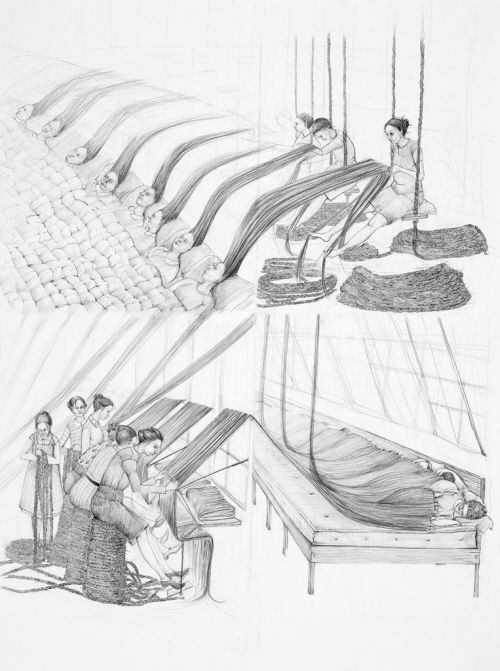
Amy Cutler. "Pilus Mill," 2007. Graphite on newspaper, 29-3/iv x 22-1/4 inches. Courtesy Leslie Tonkonow Artworks + Projects, New York.
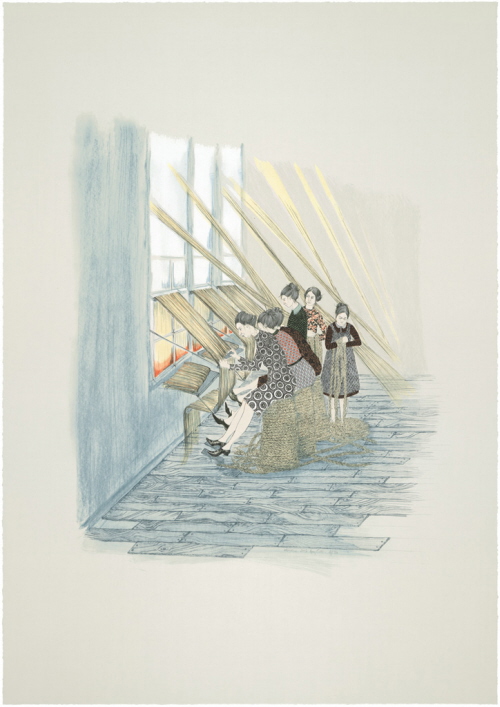
Amy Cutler. "Weavers," 2008. Lithograph in colors on Rives BFK gray, 34-1/8 10 24-ane/eight inches (canvass). Edition: 34; publisher: Universal Limited Art Editions, Bay Shore, NY. Courtesy Leslie Tonkonow Artworks + Projects, New York.
Cutler'due south recent prove at Leslie Tonkonow Artworks + Projects (closed November 5) explored the creative person's prints to date, including a number of related drawings, working proofs, and intaglio plates. Information technology is rare and welcome to run into a Chelsea gallery dedicate an exhibition to an artist'due south prints, and fifty-fifty more refreshing that pains were taken to provide contextual and working materials. Two sculptural objects with related works have been criticized equally off-topic; but they did non distract from the rich dialogue betwixt the prints and the paintings and drawings on view. For instance, the graphite drawing Hair Factory, 2007, became the source of a 2008 series of lithographs Cutler created at Universal Limited Art Editions (Groomers, Provisions, Reserves, Weavers) in which she separated its elements into four detached compositions. Working proofs further illuminated the artist'due south decisions as she worked on the series, showing experimentation with color and background details.
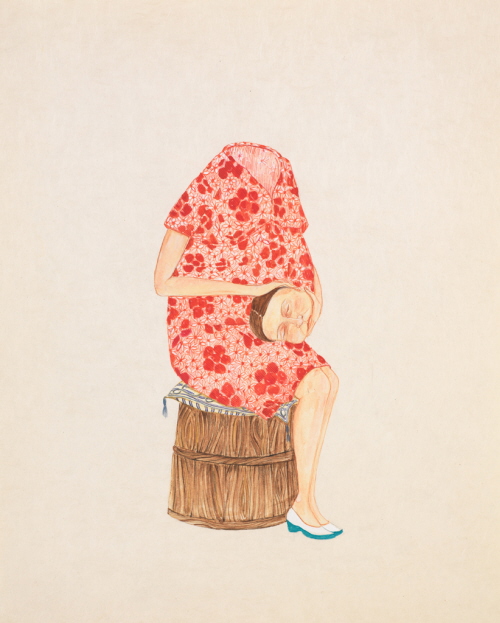
Amy Cutler. "June," 2010. Gouache on newspaper, 13 10 x-1/2 inches. Courtesy Leslie Tonkonow Artworks + Projects, New York.
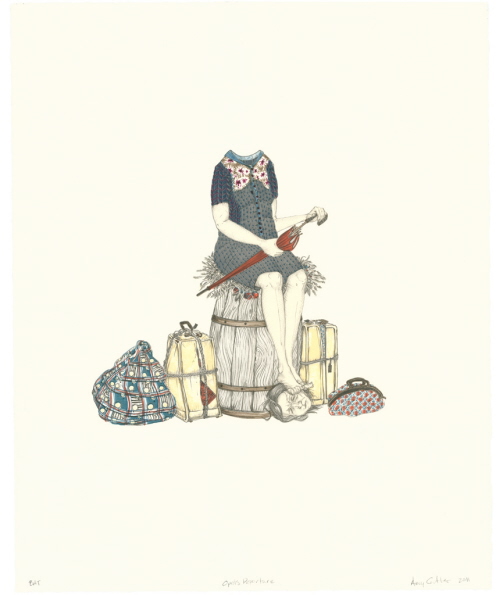
Amy Cutler. "Opal's Departure," 2011. Lithograph in colors on Fabriano Artistico Hot Printing white, fifteen-1/4 x 12-1/4 inches (sheet). Edition: 50; publisher: Universal Limited Art Editions, Bay Shore, NY. Courtesy Leslie Tonkonow Artworks + Projects, New York.
June, 2010, a gouache on paper, and Opal's Divergence, 2011, a lithograph in colors, demonstrated an entirely different relationship betwixt the two media. Both show a seated adult female whose caput is detached from her body. Though not on view at Tonkonow, some other 2010 gouache that was included in the SITE Santa Fe exhibition, April (ibid., 82), provides further insight to the artist's development of the theme. Both of the 2010 gouaches draw a woman seated on a simple implement (a metal bucket or wooden barrel) with a pillow for a cushion; June holds her head in her lap while April perches her feet atop it, as in the 2011 lithograph. The addition of suitcases and an umbrella in Opal's Deviation takes the thought a step further with a tongue-in-cheek championship that suggests dual readings; has Opal literally lost her head, or is she going somewhere, or both?
Inevitably, any discussion of Cutler's work provokes a avalanche of questions in the viewer'southward mind, with no resulting sense of closure or satisfaction; neither do they provide whatsoever moral compass or lesson. As noted by Freiman, this ambiguity is distinctly adult and rooted in the complexities of mod life (Amy Cutler [2006], sixteen). Rather than providing a pat explanation of the world or even a clever puzzle to be "solved," Cutler's women unleash the viewer'south imagination, open up possibilities for new avenues of thought, and promote an culling agreement of the world.
Amy Cutler'southward work will be featured in the post-obit upcoming exhibitions:
- Huntington Museum of Art, Huntington, West Virginia, March 17 – May 13, 2012
- University Art Museum, Academy of California, Santa Barbara, July – September 2012
- "Drawing Stories: Narration in Contemporary Graphic Arts," Museum Folkwang, Essen, Frg, May 19 – July xv, 2012
Source: https://magazine.art21.org/2011/12/09/ink-tales-for-our-time-amy-cutler%E2%80%99s-prints/
0 Response to "Amy Cutler Paintings and Drawings"
Post a Comment